Sprunki Phase 29 already looks damaged before the first performer is placed, and every new sound seems to add another layer to a scene that has gone far beyond a simple horror transformation.
What the Stage Looks Like During Play
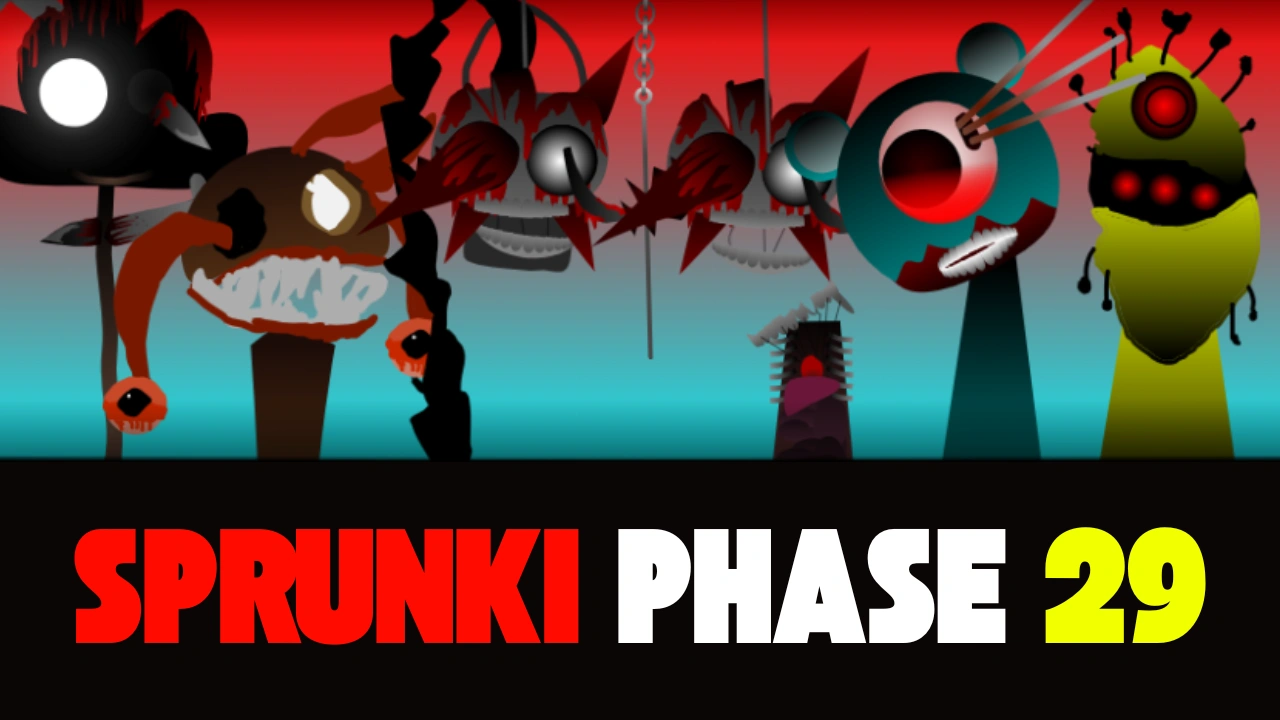
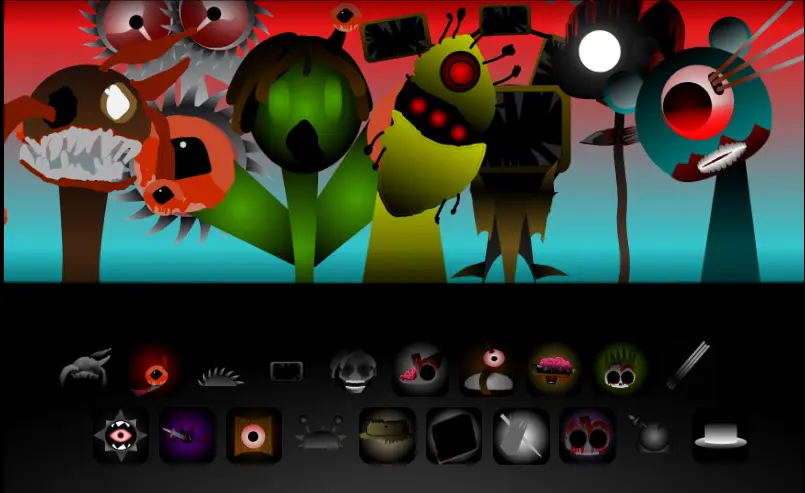
The first noticeable detail is that the stage has almost no empty space. Large faces, eyes, machinery, and damaged silhouettes overlap behind the active performers. The background does not behave like a simple backdrop; it looks like another layer of the incident.
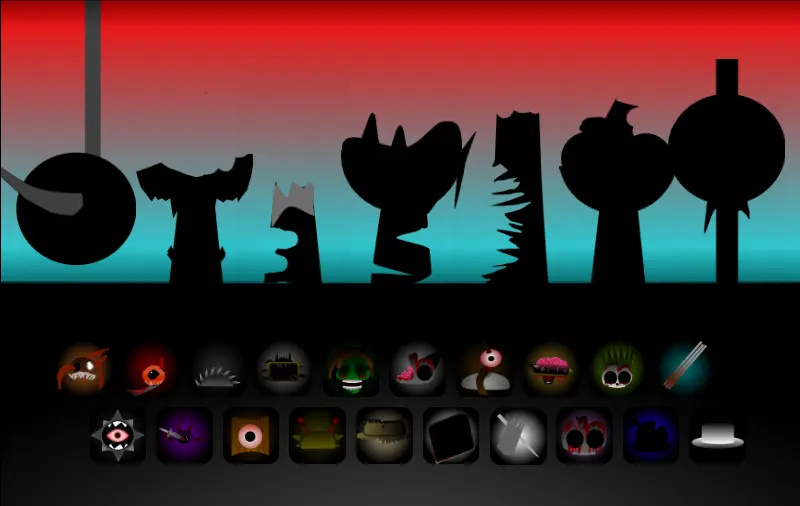
The upper half of the Sprunki Phase 29 main screen is dominated by a red sky that fades into a pale blue section near the bottom. This gives the impression that the characters are standing in shallow water, chemical residue, or the remains of a flooded facility.
The lower selection panel is almost completely black. Character icons appear as isolated objects rather than portraits. Some show eyes, mouths, helmets, broken screens, or pieces of machinery. Before a character is selected, the icon provides only a partial clue about what will appear on stage.
Once several performers are active together, the scene becomes difficult to read as a normal band. It resembles a containment room in which every subject has escaped at the same time.
Gameplay Screenshots
The Seven Performers Seen on Sprunki Phase 29 Stage
Seven main figures are visible in the captured session. Each one appears to represent a different result of the Sprunki Phase 29 mutation.
1. The Jawkeeper
The far-left performer has a long brown body and a head dominated by a wide mouth filled with uneven white teeth. Its eyes are either missing, hidden, or no longer important to the creature. The mouth has become its defining feature.
A dark arm reaches into the scene from behind it, making it unclear whether the limb belongs to the Jawkeeper or to something standing beyond the visible stage.
During play, the character creates the impression of something that reacts through biting rather than expression. There is no readable emotion in the face. The open jaw remains the only clear response.
2. The Sawbird
Next to the Jawkeeper is a smaller orange creature with a bird-like body, a black open mouth, and a circular eye. A ring of sharp grey structures surrounds part of its body.
The shapes could be feathers, teeth, blades, or fragments of a machine attached after the mutation. The character appears trapped between being alive and being used as a rotating tool.
Its small size makes it easy to overlook at first, but the surrounding spikes make the silhouette more aggressive than several of the larger characters.
3. The Hollow Bloom
The central-left figure resembles a plant with a tall green stem and two large leaves. Its head is dark green and partially covered by brown, melted material.
The face contains no visible eyes or mouth. Instead, a black opening occupies the centre of the head, making the plant appear hollow.
Small streams of dark liquid run down from the top. The character looks less violent than the others, but its stillness makes it one of the more uncomfortable figures on stage.
4. The Red Core
The yellow-green figure near the centre has a single large red eye and an open black cavity across its lower face. Three smaller red lights can be seen inside the opening. Its body appears divided into sections, as though the outer shell can open or split. Thin black wires or limbs hang from the sides.
5. The Broadcaster
Behind the Red Core stands a tall, dark figure with damaged screens across its upper body. Its lower half is covered by a torn black or brown structure resembling a coat.
Several thin wires rise from its head, and the screens display little more than black shapes or static. The figure appears to be transmitting something, although no clear message is visible.
It is one of the least expressive characters on the stage. The screens replace the face, making it impossible to determine whether the figure is observing the others or being controlled by something outside the room.
6. The White Signal
The second character from the right has an extremely thin black body and a bright white circular face. Dark shapes extend from the head, while one long arm ends in narrow, dripping fingers.
The face contains no visible expression. It resembles a lamp, a blank screen, or an overexposed eye.
Its body is so thin that it nearly disappears into the darker background. The white circle remains visible even when the rest of the stage becomes visually crowded.
7. The Open Mouth
The far-right performer has a tall cyan body and a head dominated by a large circular mouth. The inside of the mouth fades from black to red, making it look far deeper than the character’s head should allow.
Thin red beams extend from the face, while a small white row of teeth appears along the lower side. A hand or set of fingers seems to pull at the head from behind.
The character looks as though it is being forced to keep its mouth open. Whether it is screaming, singing, or absorbing the sound produced by the others is difficult to determine.
How the Session Changes
The basic interaction remains familiar: icons are selected from the lower panel and placed into available positions. The visual effect, however, is less orderly than in a normal music-mixing game.
With only one or two performers active, individual mutations are easy to examine. After several characters are added, their bodies begin to overlap with the background machinery and oversized faces.
This changes the player’s attention. The session begins as an attempt to hear each loop separately, but eventually becomes an effort to understand what is happening on the stage.
Some figures appear visually connected even when placed in separate positions. The Red Core aligns with the Broadcaster’s screens, while the White Signal and Open Mouth appear to exchange light across the right side of the stage.
Editor’s Review
The strongest part of Sprunki Phase 29 is its visual cohesion. The characters are very different from one another, but repeated details connect them. Red internal lights, dark facial openings, damaged machinery, exposed eyes, and melting or dripping surfaces make the lineup feel like the result of one shared event.
The phase is visually memorable, although not always easy to read. Players who prefer clean character presentation may find the stage too crowded. Players who enjoy environmental horror, body distortion, and speculative lore are more likely to appreciate what the mod is trying to do.
Overall, Sprunki Phase 29 feels like the aftermath of a failed experiment rather than a normal musical performance.